

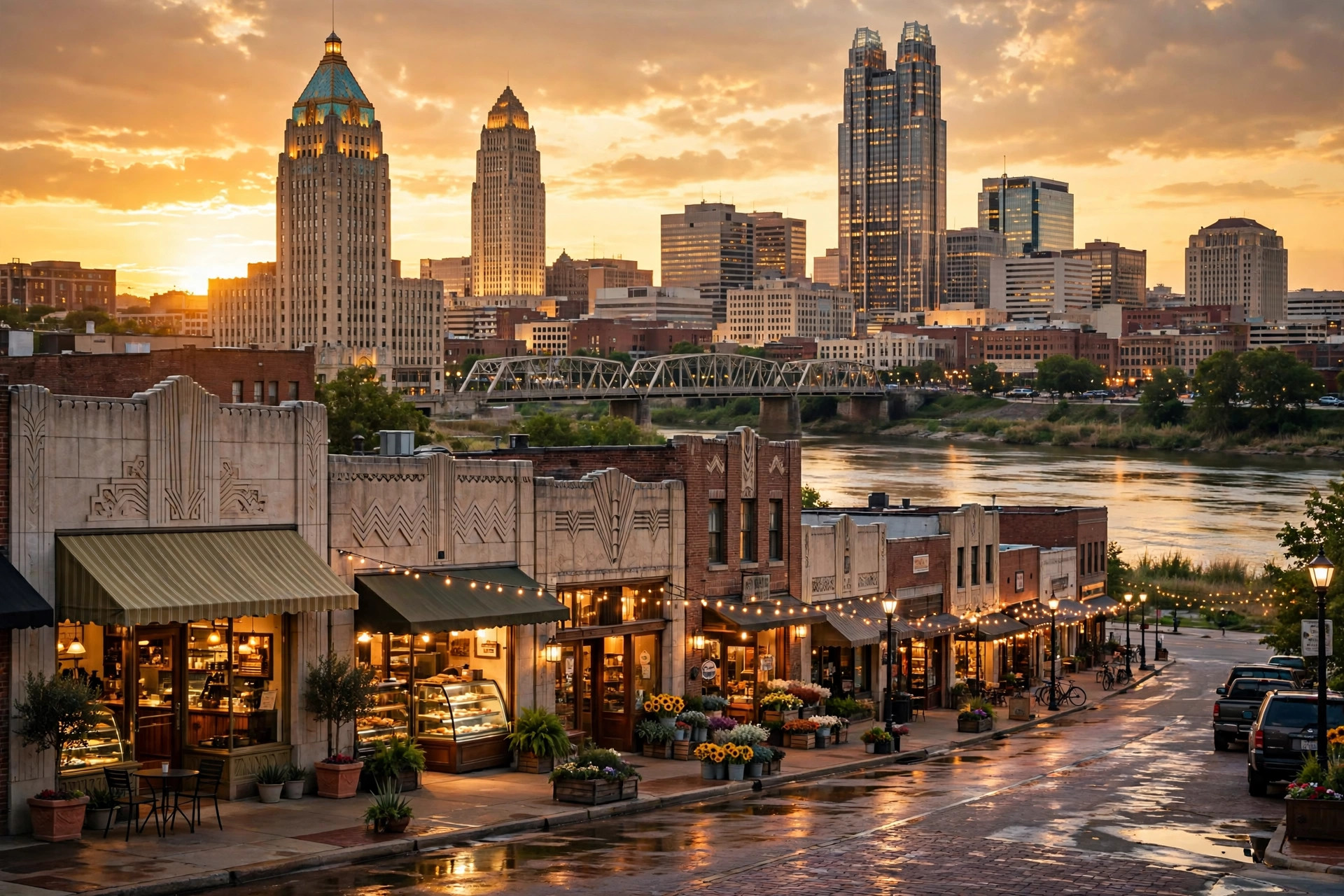
A good website for a Tulsa business does one job above all else: turn a local search into a phone call, a booking, or a visit — quickly, on a phone, in a market where energy, aerospace, healthcare and a fast-growing startup scene sit alongside Route 66 tourism and neighbourhood retail. That means fast mobile pages, clear local information, honest service and pricing signals, and search visibility for the phrases Tulsa customers actually type.
Tulsa is a city in transition, and its websites need to reflect that. The metro area supports more than 1 million residents and more than 47,000 business establishments, and 85% of Tulsa businesses have fewer than 50 employees, according to a 2026 small-business guide. This is a small-business city: the competition for a local search is usually another local business, not a national chain — which means a good local website is a genuine competitive advantage, not a formality.
How much does a business website cost in Tulsa?
There is no single honest price, because cost follows scope: page count, design, booking or ordering features, photography, content, and ongoing care. Published national ranges give a realistic planning frame — these are published ranges from other providers, not ShanVersed’s prices.
For orientation, a simple brochure site for a small business commonly lands at $1,500–$3,000, a fuller agency-built business site at $3,000–$15,000, and an e-commerce or custom build at $5,000–$15,000 or more, with ongoing hosting and maintenance at $50–$500 per month. A do-it-yourself builder costs roughly $17–$49 per month but leaves design, content and search work to the owner. Timelines follow the same curve: a typical small-business build takes 4–8 weeks, with more complex builds at 8–12 weeks or longer.
| Website type | What you get | Published range (attributed, not ShanVersed prices) |
|---|---|---|
| DIY builder site | Template, owner-built content, limited SEO control | $17–$49/month |
| Simple brochure site | 5–10 pages, mobile design, contact and enquiry steps | $1,500–$3,000 |
| Full business site | 10–20 pages, local SEO foundations, booking or quote forms | $3,000–$15,000 |
| E-commerce or custom site | Online ordering, product catalogues, custom features | $5,000–$15,000+ |
| Ongoing care | Hosting, updates, backups, content updates | $50–$500/month depending on scope |
Judge any quote by what is included, not by the headline figure: design, content, local search setup, speed optimisation, and post-launch support are where the value sits. A cheap site that never appears in local search, loads slowly on a phone, or cannot be updated without the agency is expensive in lost calls, however low its invoice.
What makes Tulsa’s market different for a website?
Tulsa’s economy is unusually diversified for a city its size. Energy and aerospace anchor the industrial base, Saint Francis, Hillcrest and Ascension St. John anchor a large healthcare sector with many independent practices, and a growing technology ecosystem is adding startups and remote workers. The U.S. Small Business Administration’s Oklahoma District Office approved more than 2,800 loans totalling over $1.2 billion in fiscal year 2024, reflecting strong demand for capital across the state — businesses here are investing, not standing still.
Two Tulsa-specific forces shape what a website must do. First, the Route 66 centennial in 2026 has driven record interest along the Mother Road corridor, with local businesses along it reporting some of their highest revenues in decades as tourism and relocation bring new customers into town. A business anywhere near the corridor — downtown, the Pearl District, Cherry Street, Brookside — should be findable by visitors who have never been to Tulsa before and are deciding from a phone. Second, Tulsa’s startup ecosystem is genuinely productive: the downtown innovation hub Gradient (formerly 36 Degrees North) reported $1.76 billion in economic impact in a single year, supporting 493 businesses and 4,400 jobs in the region. New businesses are launching constantly, which means search competition in Tulsa keeps refreshing — a site built three years ago and never updated is competing against businesses that launched last month.
Tulsa’s neighbourhoods are also distinct search markets, not interchangeable labels. Downtown and the Blue Dome District, the Deco District, Cherry Street, Brookside, the Pearl District, Utica Square, Woodland Hills, Broken Arrow, Owasso, Jenks and Bixby each carry their own customers and competitors. A business serving several of them needs location pages that say something real about each area: which services are offered there, how far away it is, and what a customer there should do next.
What should a Tulsa business website include?
Different Tulsa businesses need different conversion paths, but the foundations are the same:
- Find it fast. Business name, area, and service should be clear in seconds — not buried under a slideshow.
- Trust it fast. Real photographs, honest descriptions, genuine reviews or review links, and clear service-area information.
- Act on it fast. A phone call, booking, quote request or order step that works on a phone with as few taps as possible.
- Answer the local questions. Where you are, which areas you serve, your hours, parking or access details, and what makes you different from nearby competitors.
- Work on mobile first. Most local searches and a growing share of bookings happen on phones, so the mobile experience is the main experience.
| Business type | The website’s first job | The detail customers check first |
|---|---|---|
| Home services (HVAC, plumbing, roofing) | Emergency and quote calls | Service areas, response times, seasonal services, reviews |
| Medical and dental practices | Appointment bookings | Treatments, clinicians, insurance information, location and hours |
| Restaurants and cafes | Reservations, menus and directions | Menu, hours, location, parking, neighbourhood |
| Shops and local retailers | Foot traffic and online sales | Location, hours, featured products, directions |
| Professional services (law, accounting) | Qualified enquiries | Practice areas, team, consultation step, local credibility |
| Tourism and hospitality | Direct bookings and enquiries | Rooms or tours, real photos, location, Route 66 proximity |
A Tulsa HVAC company, for example, needs its service areas — Broken Arrow, Owasso, Jenks, Bixby — stated plainly, with a call button that works in a summer breakdown and a quote form that does not ask for a life story. A shop on Cherry Street needs real photos, clear hours, and directions a first-time visitor can follow from a phone. The structure is the same; the conversion path is specific to the business.
Should you build on WordPress or stay on a builder?
Many Tulsa small businesses start on a builder such as Wix or Squarespace, and for a hobby or side project that is fine. The case for WordPress strengthens as the business grows: you own the site, the content and the logins; you can add booking, ordering, membership or integration features without hitting a platform ceiling; and you control SEO, speed and structure at a level builders do not offer. The trade-off is responsibility — WordPress needs updates, backups and security care that a builder bundles invisibly. That care should be agreed before launch, whether the owner handles it or a maintenance plan covers it.
The wrong reason to move is a new look alone. If the platform is not the constraint, a redesign inside the current builder is cheaper. The right reason is a constraint you can name: a feature you cannot build, search visibility you cannot reach, or growth the platform cannot carry. Name the constraint before choosing the platform, and the build decision becomes straightforward.
How do Tulsa customers actually find local businesses?
Most local journeys start with a search and a map. A customer types a service plus a place — “plumber Broken Arrow,” “restaurant Cherry Street,” “dentist near Utica Square” — and decides from the map pack and the first few results. That has three practical implications.
First, the Google Business Profile is part of the website, not separate from it. Accurate name, address, hours, services and photographs, plus a steady flow of genuine reviews, decide map-pack visibility in a market where proximity is a core ranking factor. A business with no Tulsa-area address cannot win the Tulsa map pack from elsewhere, however good its website is.
Second, local pages must be specific. A page for Broken Arrow should say what is offered in Broken Arrow, not repeat the homepage with the suburb name swapped in. Search engines and customers both punish templated near-duplicates; original local substance — real service areas, real local detail, real local questions answered — is what ranks and converts.
Third, speed and mobile discipline close the enquiry. A customer comparing three businesses on a mobile connection will not wait for oversized photographs to load. Compressed images, fast hosting, and a call or booking button visible without scrolling matter more than an elaborate animation.
What mistakes cost Tulsa businesses enquiries?
The costliest mistakes are all fixable: a phone number instead of a booking step, outdated hours, one page trying to cover every service and every area, hidden prices or policies, and no easy return path for repeat customers. Separate, focused pages — one per real service, one per real service area, each with its own substance — prevent most of them.
Another common mistake is buying on price alone. The cheapest site is rarely the cheapest over two years: a template site with no local search structure, slow mobile pages, and no booking integration quietly loses calls to competitors every week. Judge any quote by what it buys in enquiry terms — local search visibility, fast mobile pages, staff-editable content, and a conversion step that works.
Honest limitations
A website, however good, cannot fix an uncompetitive price, a weak review profile, or a service customers do not want. It can present the business clearly, make contact easy, and win the local searches that matter — but the service itself still has to deliver, and reviews still have to be earned. In a market as competitive as Tulsa’s small-business scene, that honesty is also the strategy: accurate descriptions, real photographs and genuine reviews outperform polished claims that customers can check in one search.
Frequently Asked Questions
Q: How much should a small Tulsa business budget for a website?
A: Published national ranges point to $1,500–$3,000 for a simple brochure site and $3,000–$15,000 for a fuller agency-built business site, with ongoing care at $50–$500 per month. Budget in ranges, and judge quotes by what is included.
Q: How long does a Tulsa business website take to build?
A: A typical small-business site takes 4–8 weeks, with more complex or e-commerce builds at 8–12 weeks or longer. The timeline depends on content, features, and how quickly the owner provides feedback.
Q: Do I need separate pages for Broken Arrow, Owasso, and other areas?
A: Only where you genuinely serve them, and only with real local substance per page — services offered there, access details, and local questions answered. Templated pages with only the area name changed do not rank well and do not convert well.
Q: Is WordPress better than a website builder for a Tulsa business?
A: WordPress gives ownership, flexibility and deeper SEO control, which matters as a business grows. A builder is simpler and cheaper to start with. Choose on the constraint: if the builder blocks a feature or visibility you need, WordPress is the move.
Q: What is the single fastest improvement for most Tulsa business websites?
A: Make the call or booking step obvious on a phone, and make sure hours and service areas are accurate. For many businesses, that one fix recovers enquiries already being lost.
Ready to build a website that wins Tulsa customers?
A Tulsa business website should work as hard as the business it represents: appearing in the local searches that matter, answering area questions honestly, and turning a phone search into a call or booking. ShanVersed builds WordPress websites with that local-first discipline. To explore how that approach would work for your business, visit the WordPress Website Development service page and contact ShanVersed to start the conversation.