

Direct answer: A business website in San Antonio should be built for the whole metro, not just downtown: fast on mobile, found for “near me” searches across San Antonio, Alamo Heights, Stone Oak, Boerne, New Braunfels, and Schertz, and honest about what it costs. San Antonio was named the most entrepreneurial city in the US for 2026 by GoDaddy, with microbusinesses growing 11% year over year and 9,232 new businesses created in a single year — so a new site is competing in a crowded, fast-moving market. Most local businesses need a custom WordPress site with local service pages for each area they serve, clear pricing or quote paths, and a Google Business Profile that matches the website. Expect a professional small-business site to take a few weeks to build and to cost anywhere from a few thousand dollars for a focused brochure site to substantially more for e-commerce or booking-heavy builds — published agency ranges vary that widely, so get a scoped quote.
San Antonio is not one market. It is a metro where a tourist business on the River Walk, a contractor in Stone Oak, a restaurant in Southtown, and a clinic near the Medical Center all search differently and expect a local answer. A website that says “San Antonio” once on the homepage and nowhere else will not win those searches. This guide covers what San Antonio-area businesses actually need from a website in 2026: the metro’s business landscape, the suburb clusters that matter, what a site should cost, and how to get found across the metro.
Why is San Antonio such a strong market for local businesses?
Small businesses are the backbone of the San Antonio economy in a measurable way: they make up 93.1% of establishments in the San Antonio–New Braunfels metro area and account for 21% of the county workforce. Texas as a whole has around 3.3 million small businesses — 99.8% of all businesses in the state — and San Antonio is currently one of its fastest-growing entrepreneurial markets. GoDaddy’s Small Business Research Lab named San Antonio the No. 1 most entrepreneurial city in the US for 2026, tracking an 11% year-over-year growth in microbusinesses between August 2019 and March 2026, with 9,232 businesses created in the last year counted. Its researchers note that for every entrepreneur who launches a new business in a community, five new local jobs are created at the county level.
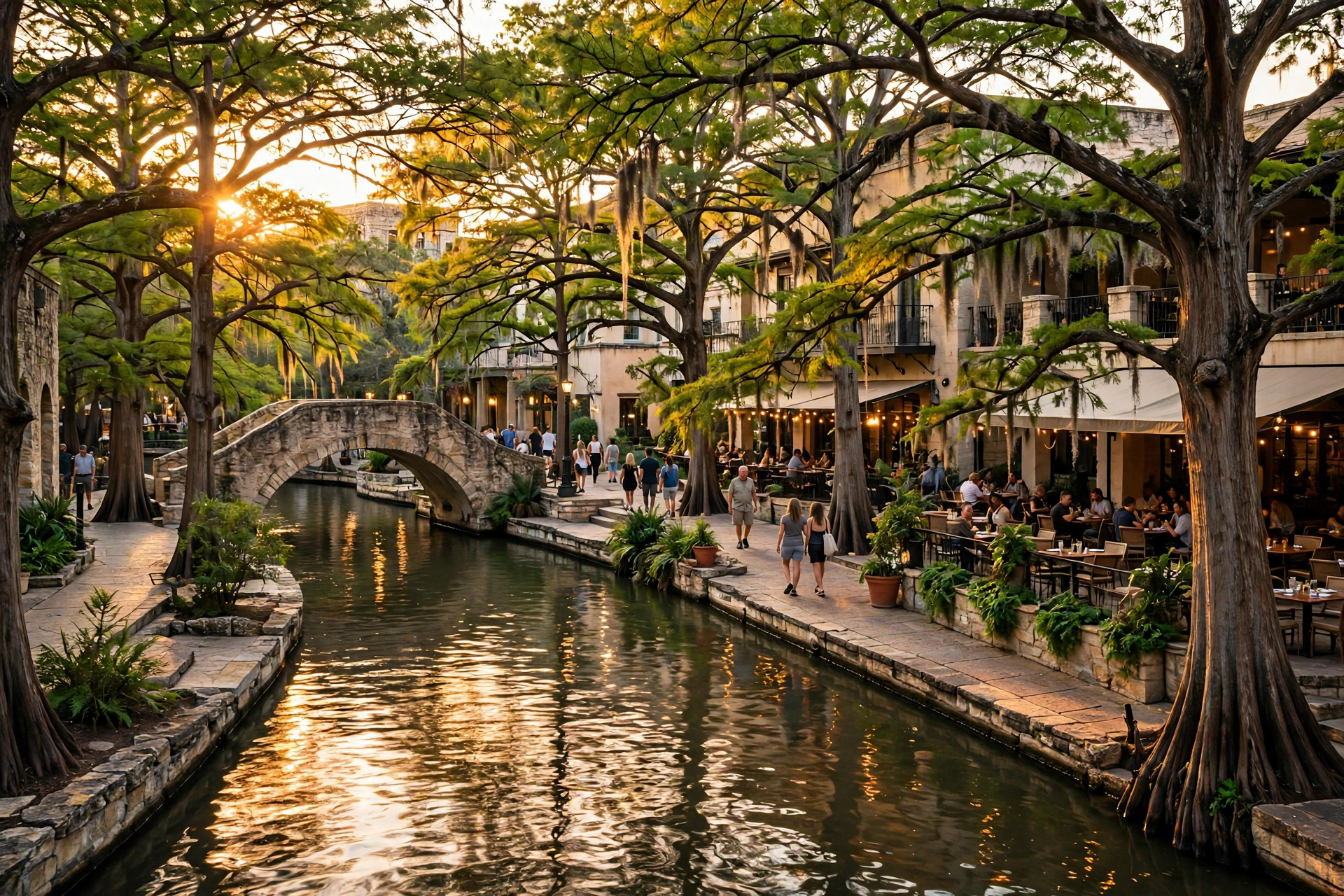
The growth drivers are unusually broad. Tourism anchors the centre: the River Walk and the Alamo draw visitors year-round, Texas tourism generates more than $190 billion a year, and San Antonio collects roughly $250–300 million a year in hotel occupancy tax revenue, with around 5,000 active short-term rental listings feeding restaurants, cleaning services, maintenance providers, and tour operators across the city. The military presence is large — Joint Base San Antonio is one of the biggest employers in the region — and healthcare is a major cluster around the South Texas Medical Center. UT San Antonio’s economic development institute reported $1.8 billion in direct economic impact, and its Small Business Development Center serves businesses across 11 counties including Bexar.
There is also an honest counterweight: San Antonio’s sales-tax allocations were down 5.65% through July 2026, about $16.4 million less than the same period in 2025, after more than a decade of growth. In a tighter market, the businesses that win online are the ones whose websites convert the visitors they already get — which is exactly what this guide is about.
Which San Antonio suburbs should your website target?
San Antonio proper is the anchor, but most businesses serve a cluster, not a single city. Build one genuinely useful page per area you actually serve — with real local detail — rather than ten thin pages that only swap the place name. The clusters that matter most:
Alamo Heights and Terrell Hills — established, high-expectation neighbourhoods. Just north of downtown, Alamo Heights is one of the metro’s most established residential areas, with a dense mix of professional services, boutiques, restaurants, and medical practices. Customers here expect polish: strong photography, clear service menus, and booking or consultation flows that match a high-expectation audience. Websites serving this area should lead with quality and trust signals.
Stone Oak and the far north side — fast-growing family suburbs. Stone Oak, Encino Park, and the surrounding far-north neighbourhoods are where many San Antonio families live, which means steady demand for home services, healthcare, childcare, fitness, and local retail. The area keeps adding housing, and new residents search for everything from dentists to roofers the week they move in. Sites serving these neighbourhoods should emphasise service areas by neighbourhood, reviews, and easy booking.
Boerne and the Hill Country corridor — tourism and lifestyle. Boerne, up I-10 from the city, blends Hill Country tourism with a growing residential base. Wineries, guesthouses, restaurants, and outdoor businesses need sites that sell an experience — photography, seasonal offers, and booking — while trades and services in the corridor need to rank for both Boerne and San Antonio searches. A Boerne page that only says “near San Antonio” misses the visitors searching for Boerne itself.
New Braunfels and Schertz–Cibolo — the growth corridor. New Braunfels, between San Antonio and Austin on I-35, is one of the fastest-growing cities in the country, and the Schertz–Cibolo–Universal City corridor on the northeast side keeps adding homes and employers. Competition is thinner here than in central San Antonio, which makes it one of the best places in the metro for a well-built local site to rank quickly. Businesses here should claim their suburb pages early, before the competition does.
The Westside, Southtown, and the Pearl — culture and small business. Southtown and the Pearl District are where much of San Antonio’s independent restaurant, gallery, and retail energy sits, and the Westside carries deep local business roots. These are neighbourhoods where customers search by district name as much as by service — “restaurant near the Pearl” or “bakery in Southtown” — so a site that names the district and speaks to it will outrank a generic San Antonio page.
The Medical Center and USAA area — professional and healthcare demand. The South Texas Medical Center and the USAA campus on the northwest side concentrate thousands of professional workers and a large healthcare economy. Clinics, professional firms, and the service businesses around them need sites that are fast, trustworthy, and easy to contact from a phone during a lunch break.
The rule for every suburb page: write about the place as if you serve it. Name the neighbourhoods, the landmarks, the local demand. A page that could describe any suburb describes none of them, and search engines increasingly treat it that way.
What should a San Antonio business website include?
Whatever your industry, the structure that converts in this market is consistent:
A homepage that answers in seconds. Who you serve, where you serve them, and what to do next — visible without scrolling. San Antonio customers compare three tabs at once; the site that states its offer plainly wins the call.
Service pages for each suburb cluster. One page per real service area, with local specifics: the neighbourhoods covered, response times, and local examples. These pages are also what let you rank for “plumber in Stone Oak” or “dentist in Alamo Heights” instead of only for generic terms.
Fast mobile performance. San Antonio is a driving metro; customers search from cars, job sites, and living rooms. A site that takes four seconds to become usable on a phone loses to the competitor whose site loaded in one.
Clear conversion paths. Call buttons that work on mobile, quote forms that ask for as little as possible, and online booking where it fits the business. Every page needs one obvious next step.
Local proof, honestly presented. Real reviews, real service-area detail, and real photos of your work. Never invent testimonials, results, or client names — San Antonio customers check, and a fabricated claim costs more than it ever gains.
A Google Business Profile that matches. Your website and your profile should agree on name, address, phone, hours, and service areas. Mismatches quietly suppress local rankings.
How much does a website cost in San Antonio?
Costs depend on scope more than on the city. As a planning guide only, published agency ranges for professional small-business websites run from a few thousand dollars for a focused WordPress site with a handful of pages, to $10,000 or more for e-commerce, booking systems, or a large set of suburb pages. Ongoing costs — hosting, maintenance, and content — are separate and should be quoted separately. Treat any published range as a starting point: the honest question to ask a developer is what is included (design, copy, suburb pages, SEO setup, speed work, post-launch support) and what would change the price. ShanVersed builds WordPress websites for service businesses — see our WordPress website development services for the full service scope.
How do San Antonio businesses get found on Google and AI search?
Local search in this metro rewards specificity. The businesses that show up for “near me” searches and in AI answers tend to do the same things: consistent business details everywhere, suburb-specific pages with real local content, direct answers to the questions customers actually ask, and a steady flow of genuine reviews. AI assistants cite pages they can read and trust — clear facts, consistent naming, and original local detail — so a San Antonio site that answers “how much does X cost in Boerne?” directly has a better chance of being cited than one that hides the answer behind a form.
There are also honest limits: no one can promise a top ranking or an AI citation, and new pages take weeks to be indexed and ranked. What a good rebuild does is put your site in the group that can be found, instead of the group that cannot.
Frequently asked questions
How much does a website cost for a small business in San Antonio?
Published agency ranges run from a few thousand dollars for a focused WordPress site to $10,000 or more for e-commerce or booking-heavy builds. The real price depends on pages, features, and content scope — get a scoped quote.
Should my San Antonio website target suburbs like Stone Oak and Boerne?
Yes, if you serve them. One genuinely useful page per suburb you actually work in, with real local detail, beats a single “San Antonio” page for suburb-specific searches.
Do I need a Google Business Profile as well as a website?
Yes. Your profile and website should agree on name, address, phone, hours, and service areas — mismatches suppress local rankings.
How long does it take to build a business website in San Antonio?
A focused WordPress site typically takes a few weeks; e-commerce, booking systems, or many suburb pages take longer.
Will a new website help me show up in AI search results?
AI assistants cite pages with direct answers, consistent business details, and original local content. No one can guarantee citation, but a site built to those standards has a real chance.
What makes a San Antonio website different from a generic one?
The metro is many markets in one — tourism downtown, military and healthcare on the northwest side, fast-growing suburbs to the north and northeast, and Hill Country tourism up I-10. A San Antonio site needs suburb-cluster pages, phone-first speed, and conversion paths matched to how local customers actually search and buy.
Getting a San Antonio website that works across the metro
San Antonio rewards businesses that treat the metro as it is: a collection of distinct neighbourhoods and suburbs, each with its own customers, competitors, and search behaviour — and, right now, the most entrepreneurial city in America. A website built for that reality — fast, local, honest, and easy to act on — is how a San Antonio business gets found and chosen. If your current site only says “San Antonio” and hopes for the best, it is time to build one that speaks to the whole metro.
ShanVersed builds WordPress websites for service businesses across the US, including the suburb-cluster structure described here — see our WordPress website development services. To discuss a website for your San Antonio-area business, get a free consultation.