Hiring a WooCommerce developer in 2026 typically costs $15–$200 per hour, depending on the hiring route, the developer’s experience, and where they are based. Platforms publish clear ranges: open marketplaces like Upwork list WooCommerce experts from around $15/hr up to $125/hr, vetted WordPress-only platforms like Codeable publish rates of $80–$120/hr, and specialist agencies generally bill $100–$250/hr. A small customization might cost a few hundred dollars; a full custom store build can run $5,000–$30,000+. This guide walks you through what a good developer actually does, the skills that matter, where to find vetted talent, and the questions that separate real experts from risky hires.
What Does a WooCommerce Developer Actually Do?
A WooCommerce developer builds and customizes online stores on WordPress’s WooCommerce platform. That sounds simple, but the work spans several distinct disciplines:
- Theme customization — adapting a storefront theme (or building a custom one) so the store looks and feels like your brand, including responsive layouts and checkout flow design.
- Custom plugin development — building bespoke functionality WooCommerce doesn’t offer out of the box, such as subscription workflows, custom pricing rules, or industry-specific product configurators.
- Payment and shipping integrations — connecting gateways (Stripe, PayPal, Apple Pay), carrier APIs (FedEx, UPS, DHL), and tax calculation services so checkout actually works end to end.
- Performance optimization — caching, image compression, database tuning, and asset cleanup, because a slow store leaks revenue on every page view.
- Checkout UX and conversion work — simplifying cart and checkout flows, reducing friction, and A/B testing improvements that lift the store’s conversion rate.
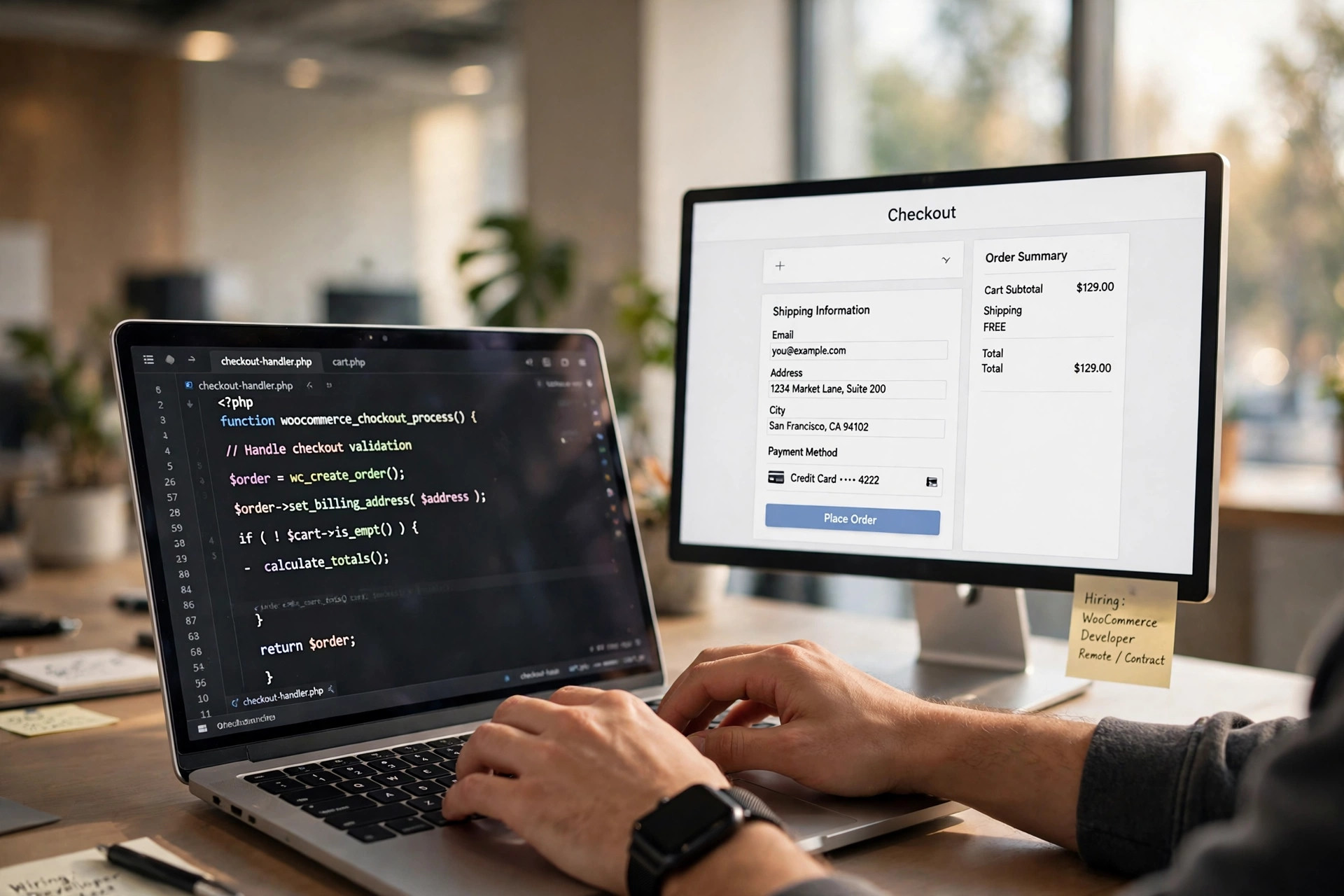
This is not a job for a generalist. Touching the checkout process is high risk — one industry cost guide notes that a single checkout bug can silently kill all orders, which is why checkout customization adds 30–50% more development and testing time than comparable work elsewhere in the store.
How Much Does It Cost to Hire a WooCommerce Developer?
Hourly Rates by Provider Type
Published 2026 rate data gives a consistent picture across sources:
| Provider type | Published hourly rate | Source |
|---|---|---|
| Solo freelancer (low-cost region) | $25–$60/hr | progressus.io 2026 guide |
| Freelancer (South / Southeast Asia) | $15–$40/hr | amanurrahman.com |
| Freelancer (Eastern Europe) | $30–$85/hr | ecomsupport360.com / amanurrahman.com |
| Solo freelancer (US / EU) | $65–$175/hr | ecomsupport360.com |
| Codeable vetted experts | $80–$120/hr (+17.5% service fee) | codeable.io (published) |
| Boutique WooCommerce agency (2–10 people) | $100–$180/hr | progressus.io 2026 guide |
| Specialist enterprise agency | $120–$240/hr | progressus.io 2026 guide |
| E-commerce companies on Clutch | $25–$49/hr (majority band) | clutch.co pricing guide |
Upwork’s own hiring page states that WooCommerce experts generally cost $15–$29 per hour, with rates rising to $125 per hour depending on complexity and experience.
Typical Fixed Project Costs
Hourly rates only tell half the story. Published project ranges from Upwork’s WooCommerce hiring guide:
| Project | Published range |
|---|---|
| Theme customization or bug fixes | $500–$2,000 |
| Custom feature or plugin development | $2,000–$6,000 |
| Full store build or redesign | $5,000–$15,000+ |
| Ongoing optimization and support | $1,000–$3,500 |
Independent guides put a standard full store build at $3,000–$10,000, complex builds at $10,000–$30,000+, and enterprise work (ERP/CRM integrations, multi-vendor platforms, headless builds) at $25,000–$100,000+.
Hiring Route Comparison: Freelancer vs Marketplace vs Agency
| Freelance Marketplace (e.g. Upwork) | Vetted Platform (e.g. Codeable) | Specialist Agency (e.g. ShanVersed) | |
|---|---|---|---|
| Typical cost | $15–$125/hr (platform-published) | $80–$120/hr + 17.5% fee (platform-published) | $100–$250/hr (industry-published) |
| Vetting | You do it yourself — reviews, job success score, portfolios | Multi-stage: coding tests, test projects, interviews (top ~2% accepted) | Portfolio + references; team structure does the screening |
| Best for | Small, well-scoped tasks and simple stores | Mid-complexity projects with quality guarantees | Full builds, complex integrations, ongoing partnerships |
| Risk | Highest variance — quality ranges widely; verify carefully | Lower — 28-day bug-fix warranty, escrow, fixed-price estimates | Lowest — team coverage if someone is unavailable, structured QA |
| Hidden cost | Your time vetting + possible rework | Service fee is built into estimates (transparent) | Higher headline rate buys design, PM, and QA alongside code |
One useful way to think about rates, published by a 2026 WooCommerce cost guide: a $120/hr senior developer who finishes a task in 4 hours costs $480. A $40/hr junior who takes 20 hours on the same task costs $800 — and is more likely to ship bugs that need another round of fixes. The hourly rate alone is a poor proxy for value.
What Skills Should a WooCommerce Developer Have?
When you hire a WooCommerce developer, look for a specific mix of technical and professional skills. Codeable’s hiring guide and Toptal’s WooCommerce screening both converge on this core list:
Technical skills (non-negotiable):
- PHP — the core language of WordPress and WooCommerce; needed for every custom feature, hook, and plugin.
- WordPress hooks and filters — the correct way to extend WooCommerce without touching core files (changes written directly into plugin or theme files get wiped out by updates).
- WooCommerce APIs — hooks, template overrides, the REST API, and database structures, so custom work survives plugin updates.
- Frontend: HTML, CSS, JavaScript — for storefront customization, checkout flow changes, and interactive elements.
- Payment gateway and shipping integration — experience connecting real gateways and carriers, not just installing plugins.
- MySQL fundamentals — understanding how product, order, and customer data is stored, essential for migrations and performance work.
- Performance optimization — caching, CDN setup, image compression, and asset optimization.
- Security hardening — protecting customer data, patching vulnerabilities, and safe update workflows (staging environments, backups).
Professional skills (equally important):
- E-commerce business sense — they should think about conversion and revenue, not just code.
- Clear communication and reliable work habits.
- Staging-and-backup discipline: no serious developer tests on a live store.
Red flag: a candidate who can’t explain how they’d customize a theme without losing changes on the next update. The correct answer involves child themes, custom plugins, and hooks — anything else is a sign of inexperience. For a deeper look at what professional store development involves, see ShanVersed’s e-commerce development services.
Where to Find WooCommerce Developers
1. Codeable — the WordPress-only vetted platform
How it works: you post a project and receive a single fixed-price estimate from pre-vetted WordPress/WooCommerce experts, backed by escrow and a 28-day bug-fix warranty.
Pros: rigorous WordPress-specific vetting, no bidding wars, transparent pricing ($80–$120/hr published rate, 17.5% fee included in estimates), projects typically matched within hours.
Cons: premium pricing for small tweaks; the platform only does WordPress — useless if your project later grows beyond it.
2. Upwork — the open marketplace
How it works: you post a job and receive competing proposals from freelancers worldwide.
Pros: widest choice and lowest entry prices (published $15–$125/hr range); escrow, hourly tracking, and payment protection are built in.
Cons: you do all the vetting. Look for 90%+ job success scores, Top Rated badges, WooCommerce-specific portfolio items, and at least 10 completed jobs. Quality varies enormously — a published pro tip warns that uncorroborated profiles from stale listings are high risk.
3. Specialist agencies — including ShanVersed
How it works: you hire a team that designs, builds, tests, and supports the store as one engagement.
Pros: consistent quality, design + project management + QA included, team coverage means no single-person dependency, and a long-term partner who already understands your store when you need changes. ShanVersed builds custom WooCommerce stores as part of its e-commerce development services — one team from design through launch and ongoing support.
Cons: highest headline cost ($100–$250/hr industry range); overkill for a one-off tweak.
When an agency wins: full builds, complex integrations, and stores where downtime costs real money.
10 Vetting Questions to Ask Before You Hire
Ask these on any call — the quality of the answers tells you more than any portfolio:
- “Show me 2–3 WooCommerce stores you personally built, and tell me exactly what you did on each.” Vague credit-claiming is a red flag.
- “How do you customize a theme without losing changes when it updates?” Expect: child themes and hooks. Anything else is a fail.
- “Walk me through how you’d add a custom payment gateway.” Reveals whether they’ve done real integration work.
- “How do you test changes before they go live?” Expect: staging environment, backups, and a rollback plan.
- “How do you handle plugin conflicts?” Every WooCommerce store hits them; they should have a debugging method.
- “What do you do to keep a store fast as the catalog grows?” Look for caching, image strategy, and database awareness.
- “How do you secure customer and payment data?” Non-negotiable for any store handling transactions.
- “What happens if something you built breaks a month later?” You want a clear warranty or support arrangement — Codeable publishes a 28-day bug-fix warranty as a benchmark.
- “Can you explain a technical decision to me in plain English?” You’ll be working with this person; communication is the job.
- “What’s something you’d push back on if I asked for it?” The best developers protect you from bad ideas — a yes-to-everything hire is a liability.
Instant disqualifiers: no portfolio, edits plugin/theme core files directly, no staging process, can’t name a single WooCommerce hook, or quotes a full custom build without asking about your products, customers, or goals first.
When You Don’t Need a WooCommerce Developer (Honest Limitations)
Hiring a developer is sometimes the wrong move. Be honest with yourself first:
- A simple store with standard products — WooCommerce plus a good theme and off-the-shelf plugins (payments, shipping, SEO) covers most small catalogs with zero custom code.
- A single well-defined feature — check the WooCommerce extension marketplace first. A $79 plugin you install in an afternoon beats a $2,000 custom build for standard needs like bookings, subscriptions, or wholesale pricing.
- Design-only changes — many “I need a developer” requests are actually design requests solvable with a page builder or a better theme.
- You haven’t validated the business yet — if you’re still testing whether anyone wants the product, spend the budget on inventory and marketing, not custom development.
The plugin-first rule: if a maintained, well-reviewed plugin solves 90% of the problem, use the plugin. Hire a developer for the remaining 10% — or when off-the-shelf options genuinely can’t do what your business needs. A good developer will tell you this themselves; one who invents custom work for standard problems is selling you hours, not outcomes.
Frequently Asked Questions
How much does it cost to hire a WooCommerce developer?
Published 2026 ranges run from about $15/hr for entry-level freelancers on open marketplaces, through $80–$120/hr on vetted platforms like Codeable, up to $100–$250/hr for specialist agencies. Fixed projects typically run $500–$2,000 for theme tweaks, $2,000–$6,000 for custom features, and $5,000–$15,000+ for full store builds.
What is the average hourly rate for a WooCommerce developer?
There is no single average — the published ranges vary by region and channel. Upwork publishes $15–$29/hr as typical for WooCommerce experts on its platform (up to $125/hr for complex work), while a 2026 industry guide places experienced US/EU freelancers at $65–$175/hr and boutique agencies at $100–$180/hr.
Codeable vs Upwork for WooCommerce — which is better?
Codeable is better when you want pre-vetted WordPress specialists, a fixed-price estimate, and a 28-day bug-fix warranty without doing the screening yourself ($80–$120/hr published). Upwork is better when budget matters most and you can vet candidates yourself ($15–$125/hr published range). For full builds and long-term partnerships, a specialist agency is usually the safer bet.
What skills should a WooCommerce developer have?
PHP, WordPress hooks and filters, WooCommerce APIs (including REST), HTML/CSS/JavaScript, payment gateway and shipping integration experience, MySQL fundamentals, performance optimization, and security hardening — plus e-commerce business sense and clear communication.
Do I need a developer or can I use plugins?
Use plugins first: most standard features (subscriptions, bookings, wholesale pricing, advanced shipping) have mature, well-reviewed extensions. Hire a developer when no plugin fits your workflow, when checkout or integrations need custom logic, or when performance and conversion need expert attention.
How long does it take to build a WooCommerce store?
A standard store with a customized theme typically takes 2–6 weeks; a fully custom build with integrations runs 2–4 months. Rush timelines usually add 20–50% to the cost, according to published industry guides — plan ahead.
Get a Store Built Right the First Time
Hiring the right WooCommerce developer comes down to three things: knowing the published cost ranges so you can spot outliers, verifying the skills that actually matter (PHP, hooks, gateway integrations, and a staging discipline), and asking the questions that reveal how a candidate really works. Whether you go the marketplace route, a vetted platform, or a specialist team, the cheapest quote is rarely the cheapest outcome.
If you’d rather hand the whole build — design, development, payment and shipping integrations, performance, and launch — to one accountable team, ShanVersed builds custom WooCommerce stores as part of its e-commerce development services. Get a Free Consultation and tell us what you’re selling — we’ll give you an honest assessment of what your store actually needs, including when the answer is “a plugin, not a developer.”